WHO SMART Guidelines explained: how WHO turns its recommendations into digital adaptation kits and FHIR guides, and why it matters for Senegal and Africa.
In short
- WHO SMART Guidelines turn WHO's written recommendations into documented requirements, coded data and FHIR implementation guides that software can follow.
- WHO lists nine digital adaptation kits published between 2021 and 2025, from antenatal care and HIV to tuberculosis and immunization.
- The content is software-neutral: countries adapt it to their own policies and tools, which WHO says lowers development costs and reduces vendor lock-in.
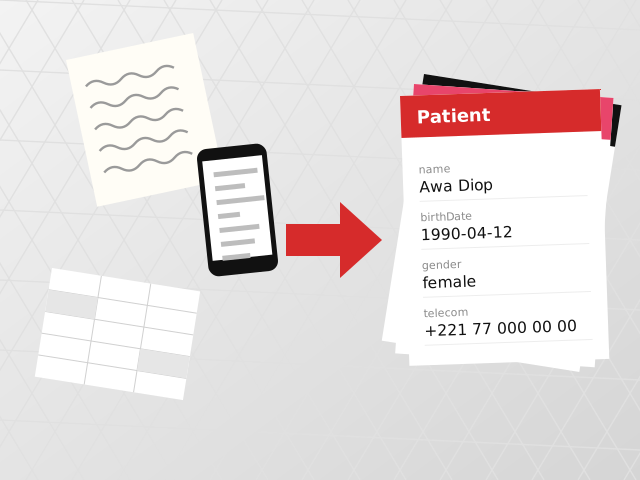
Awa is pregnant and comes to a health centre in Pikine for her first antenatal visit. Since 2016, WHO has recommended eight contacts during pregnancy instead of four, with the first in the first 12 weeks. The midwife knows this. The question is whether the software on her desk knows it too, and whether it counts Awa's visits the same way as the software in the next district.
WHO SMART Guidelines are WHO's answer to that question. This article explains what they are, how a written recommendation becomes something a computer can apply (the five layers, L1 to L5), which health topics are already covered, and why this matters for health systems in Senegal and across Africa.
The problem: guidelines written for people
WHO guidelines are written as text for health workers and policy makers. Software developers need something else: exact data fields, decision rules and indicator formulas. A 2022 paper by WHO authors in Global Health: Science and Practice notes that narrative recommendations "often do not provide sufficient detail to be converted into the technical specifications that software developers require."
So every vendor interprets the same recommendation in its own way. The paper lists the consequences: misinterpretation, decisions that cannot be traced back to the evidence, recommendations dropped along the way, and documentation that is often proprietary, which ties health programmes to one supplier.
What SMART Guidelines are
WHO launched its first SMART Guideline, for antenatal care, on 18 February 2021. SMART stands for Standards-based, Machine-readable, Adaptive, Requirements-based and Testable. In plain terms, the content uses international data standards, computers can read it, countries can adjust it, it states clearly what software must do, and it can be checked.
"SMART Guidelines are a pioneering approach to digital health systems transformation." — Dr Soumya Swaminathan, WHO Chief Scientist, WHO news release (2021)
Two design choices matter for countries. The content is software-neutral, so it can be built into whatever platform a country has chosen. And WHO's SMART Guidelines page presents the approach as a pathway that works "even if a country is not yet fully digital".
The five layers, from L1 to L5
SMART Guidelines organise knowledge in five layers. Each layer turns the previous one into something more precise. WHO's immunization kit uses this structure to show what exists at each level.
| Layer | What it is | Antenatal care example |
|---|---|---|
| L1 Narrative | The published WHO guideline, written for people | Eight contacts during pregnancy, the first within 12 weeks |
| L2 Operational | A digital adaptation kit: software-neutral requirements | Data to collect at each contact, decision rules, indicators |
| L3 Machine-readable | A FHIR implementation guide with coded data and logic | Profiles, code lists and decision logic a FHIR system can load |
| L4 Executable | Software that runs the logic | A reference application or a country's own system |
| L5 Dynamic | Systems refined with data and analytics | Still to come: the immunization kit lists it as not yet available |
Most of the practical work today happens at L2 and L3, which is where the next two sections go.
Digital adaptation kits: the guideline as a specification
A digital adaptation kit (DAK) is the L2 layer. The 2022 paper calls it "an operational and software-neutral mechanism" and lists its eight components: the recommendations themselves, generic personas (who does what), user scenarios, business processes and workflows, core data elements, decision-support logic, indicators, and functional and non-functional requirements.
The WHO SMART Guidelines page lists nine published kits:
- antenatal care (2021) and family planning (2021);
- HIV, second edition (2024), tuberculosis (2024), and child health from 0 to 59 months in humanitarian emergencies (2024);
- immunizations, birth defects surveillance, postnatal care, and self-monitoring of blood pressure during pregnancy (all 2025).
WHO says SMART Guidelines for sexually transmitted infections, community health and campaign payments are in development. The paper's authors stress that a kit is a team document: programme leads, health information officers, implementers and software developers have to read it together and adapt it to national policy.
From kit to code: FHIR implementation guides
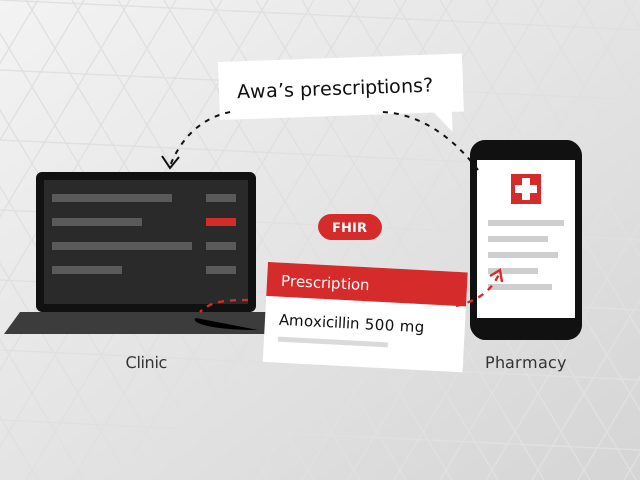
At L3, the kit becomes a FHIR implementation guide. FHIR is the international standard for exchanging health data (our page FHIR, simply explains it), and an implementation guide is a published rulebook that says exactly which data to record, in which codes, and how. A system that follows the guide records Awa's contacts in the same structure as any other system that follows it.
For the technical reader
The HIV guide reached version 1.0.0 in July 2025, on FHIR R4. It defines profiles, extensions and terminology, and its decision-support PlanDefinitions and indicator Measures use CQL (Clinical Quality Language), which a CQL engine can run against FHIR resources. The immunization guide is being developed in the open: its continuous build stood at version 0.2.0 on 1 October 2026, marked as not yet an authorized publication.
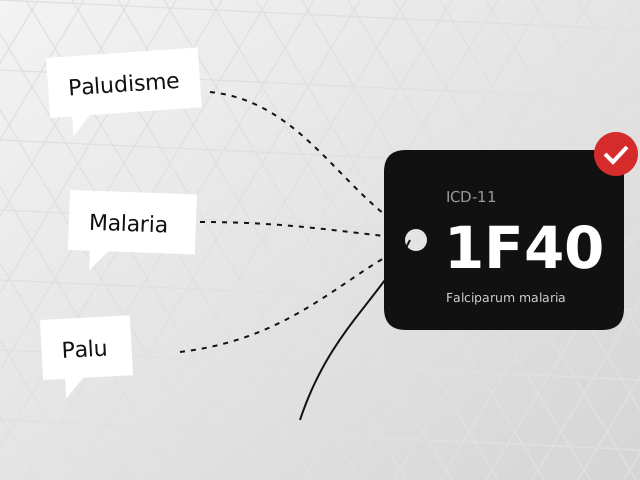
In July 2023, WHO and HL7 International signed a Project Collaboration Agreement to support the adoption of open interoperability standards. Its objectives include globally applicable specifications that countries can adapt, the use of WHO classifications (the family that includes ICD-11) in the FHIR community, and testing environments.
National platforms are aligning too. DHIS2, the national health information system in Senegal and many African countries, states that its configuration can be mapped to standard FHIR profiles, "providing compatibility with national FHIR patient profiles and WHO SMART guidelines" (DHIS2). Our article on DHIS2 and FHIR goes further.
Why it matters for African health systems
Several African countries have already tested the approach:
- Rwanda and Zambia aligned their national antenatal care guidelines with the 2016 WHO recommendations, then tailored WHO's reference digital module to each country. Testing found bugs that were fixed, and dashboards were added for facility-level monitoring (PLOS Digital Health, 2025).
- Cameroon upgraded the BornFyne prenatal system using the antenatal care kit. Up to 40% of the kit's data dictionary already existed in the first version; the work was piloted in four districts, and some elements were postponed for lack of resources (Frontiers in Pharmacology, 2025).
- Ethiopia, Namibia and Ghana took part in WHO implementation research on fitting the kits into existing national systems (WHO, 2022).
Key idea A SMART Guideline does not tell a country which software to buy. It tells every software the same thing: what to record, how to code it and how to count it.
WHO argues that the specifications lower the cost of software development, help ensure vendors deliver minimum functionality and reduce vendor lock-in. For a country like Senegal, where many apps coexist with a national DHIS2, a shared reference means two systems can count Awa's visits the same way, and the national indicator is built from comparable data. The codes behind it are explained in our article on health codes.
There are limits. WHO stressed at launch that the approach depends on governance and on resources for people and processes, not only on technology, and the Cameroon team had to postpone parts of the kit. A guideline becomes digital only when someone pays for the adaptation, the training and the maintenance.
How Quralys approaches this
Quralys's first product is a booking and practice suite for private doctors in Dakar, not a clinical decision-support tool, and it does not implement any WHO kit today. What it shares with SMART Guidelines is the foundation: every record is written as a standard FHIR R4 resource, the version WHO's HIV and immunization guides are built on, with international codes such as ICD-11 and LOINC.
That matters for later. If a clinic or a national programme adopts a WHO-based guide, data that is already FHIR and coded needs aligning with profiles, not rebuilding from scratch. The vision page explains how Quralys sees a shared FHIR layer growing from Senegal to the region.
Sources
- WHO: New guidelines on antenatal care for a positive pregnancy experience (2016)
- Global Health: Science and Practice: Transitioning to digital systems, the role of WHO's digital adaptation kits (2022)
- WHO: From paper to digital pathway, WHO launches first SMART Guidelines (2021)
- WHO: SMART Guidelines
- WHO SMART: Digital adaptation kit for immunizations
- WHO SMART: HIV implementation guide
- HL7 FHIR build: WHO Immunization Implementation Guide (continuous build)
- WHO: WHO and HL7 collaborate to support adoption of open interoperability standards (2023)
- DHIS2: DHIS2 and FHIR
- PLOS Digital Health: Adapting the WHO ANC digital module for the NAMAI study (2025)
- Frontiers in Pharmacology: Integrating WHO's digital adaptation kit for antenatal care into BornFyne-PNMS (2025)
- WHO: SMART Guidelines digital adaptation kits, implementation research and technical support (2022)
Written by the Quralys team
Quralys is building a FHIR-native health ecosystem in Senegal: one record that clinics, pharmacies, labs, insurers and the national system can read, with the patient’s consent.
See it in practice
Private doctors in Dakar can join the pilot: online booking, prepaid consultations, digital ordonnances and video, free during the pilot.