ICD-11, LOINC, ATC and SNOMED CT explained simply: what each code list covers, how FHIR carries the codes and what shared codes would change for clinics in Senegal.
In short
- A code is a stable label for one precise meaning: ICD-11 names the diagnosis, LOINC the lab test, ATC the medicine and SNOMED CT the clinical detail.
- ICD-11, published by WHO and in effect since 2022, and LOINC, from the Regenstrief Institute, are free to use; SNOMED CT is licensed, with fee exemptions for some countries.
- FHIR carries codes in a standard way, so a diagnosis written in Plateau can be counted, reimbursed and checked anywhere without being retyped.
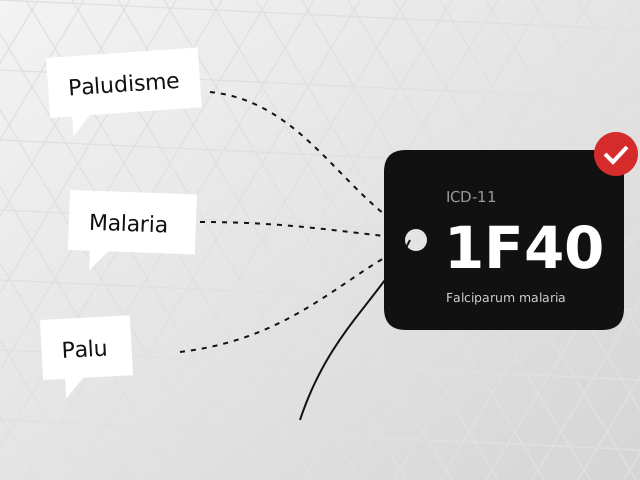
In the same week in Dakar, a doctor in Plateau writes "paludisme" in a file, a lab in Parcelles Assainies reports a positive test for "P. falciparum", and a clinic's billing software records "palu". A person reads all three as the same disease. A computer sees three unrelated words, so the case is counted three different ways, or not at all.
Codes fix this. This article explains the four code lists that health systems use most, ICD-11, LOINC, ATC and SNOMED CT, what each one is for, how the FHIR standard carries them and what shared codes would change for clinics, labs and pharmacies in Senegal. No IT background is needed.
Why words are not enough
A code is a short, stable label attached to one precise meaning. The words around it can change with the language, the doctor or the software; the code does not. That makes three things possible.
- Counting. National statistics, such as how many malaria cases were seen this month, add up codes, not spellings.
- Checking. Software can warn about a drug interaction or a dose only if it knows exactly which medicine was prescribed.
- Paying. An insurer or a mutuelle can process a claim automatically when the diagnosis and the treatment are coded.
The catch is that one list cannot cover everything. Diagnoses, lab tests and medicines are described by different families of codes, each maintained by a different organisation.
ICD-11: the diagnosis
The International Classification of Diseases is published by the World Health Organization. Its eleventh revision, ICD-11, came into effect in 2022. WHO describes it as entirely digital, with "around 17 000 unique codes" and "more than 120 000 codable terms", and freely available through an open licence.
ICD is the list countries use to report causes of death and illness, which makes it the natural code for a diagnosis. In ICD-11, malaria due to Plasmodium falciparum, the species behind most cases in West Africa, is code 1F40. Whether the file says paludisme, malaria or palu, the record can carry 1F40, and every system reads the same disease.
ICD-11 also comes with an online browser and a coding tool, so a doctor can search in plain words and pick the code, rather than learn codes by heart.
LOINC: the lab test
LOINC, for Logical Observation Identifiers Names and Codes, names lab tests and clinical measurements. It was initiated in 1994 at the Regenstrief Institute in the United States, and its licence says it is "free for use in both commercial and non-commercial systems".
A LOINC code says precisely what was measured, in what and how. Haemoglobin measured as a mass concentration in blood, for instance, is LOINC 718-7. That precision matters: two labs can call a test by the same short name and still measure different things. With LOINC, the doctor's software knows that this month's result can be compared with last month's, and can draw the trend.
ATC: the medicine
The Anatomical Therapeutic Chemical classification sorts medicines by the organ or system they act on and by their chemical substance. It is maintained by the WHO Collaborating Centre for Drug Statistics Methodology at the Norwegian Institute of Public Health, in Oslo, and WHO describes a classification in five levels, from the broad group down to the single substance.
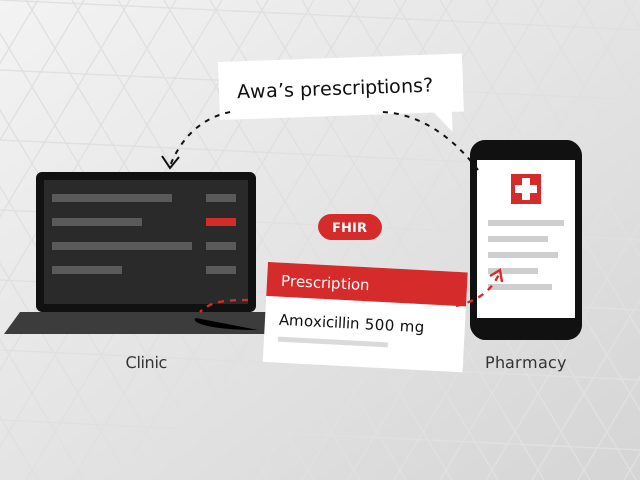
Amoxicillin, one of the most prescribed antibiotics, is ATC J01CA04: J for anti-infectives for systemic use, down to the substance itself. ATC codes the active substance, not the brand: a box from one manufacturer and a box from another share the same code. That is exactly what a pharmacy needs to read a prescription correctly and what public health needs to follow antibiotic use.
SNOMED CT: the clinical detail
SNOMED CT is the most detailed of the four: a clinical terminology that can describe findings, procedures, body sites and much more, with relationships between concepts. It is maintained by SNOMED International and used under a licence. Membership and licensing depend on the country, and SNOMED International lists low-income countries among the categories available for fee exemption.
For many first projects, SNOMED CT is not the starting point: ICD-11, LOINC and ATC already cover diagnoses, lab tests and medicines, and are free. SNOMED CT becomes useful when clinical records need finer detail than a diagnosis code, and each country decides whether and how to license it.
Key idea
Each list answers one question. ICD-11: what does the patient have? LOINC: what was measured? ATC: which medicine? SNOMED CT: what exactly was observed or done?
How FHIR carries a code
FHIR, the international standard for exchanging health data, has one way of carrying a code, the same in every resource. Each coded field holds the list the code comes from (its "system", written as a web address), the code itself and a human-readable label. A diagnosis of falciparum malaria travels as the system for ICD-11, the code 1F40 and the label "Malaria due to Plasmodium falciparum"; an ordonnance for amoxicillin carries the ATC system and J01CA04.
| List | What it codes | Published by | Example | Cost |
|---|---|---|---|---|
| ICD-11 | Diagnoses, causes of death | WHO | 1F40, falciparum malaria | Free, open licence |
| LOINC | Lab tests, measurements | Regenstrief Institute | 718-7, haemoglobin in blood | Free |
| ATC | Medicines (active substance) | WHO Collaborating Centre, Oslo | J01CA04, amoxicillin | Free to consult |
| SNOMED CT | Detailed clinical terms | SNOMED International | Findings, procedures | Licence; fee exemptions exist |
A field can even carry several codes at once: the doctor's own words, the ICD-11 code and, later, a SNOMED CT code, side by side. Nothing is lost, and each reader uses the code it understands. Our plain-language guide to FHIR explains the rest of the standard.
What shared codes would change in Senegal
Codes are only useful if everyone agrees on them. For Senegal, three choices matter.
- One list per kind of information. Clinics, labs, pharmacies and insurers need to use the same lists, so that a diagnosis coded in a private clinic means the same thing to an insurer and to the national health information system.
- French labels. Codes are language-neutral, but screens are not. Doctors should search and read in French, while the record stores the international code underneath.
- Mapping what exists. Many programmes already keep their own lists. They do not need to be thrown away: each local item can be mapped once to the international code, and the mapping published for everyone.
The national health information system, DHIS2, counts cases by programme and indicator. When clinical software records coded diagnoses rather than free text, those counts can be produced without retyping, as we explain in DHIS2 and FHIR.
How Quralys approaches this
Quralys is a FHIR-native platform being built in Dakar, ahead of launch. In its doctor suite, the doctor types in plain French and picks from suggestions; the record stores the international code underneath: ICD-11 for the diagnosis, ATC for each medicine on the ordonnance and, as labs join, LOINC for results. The doctor never has to learn a code.
Because the codes are international, the same record can later be read by a pharmacy, an insurer or the national system, with the patient's consent. You can see how codes fit into the bigger picture on our FHIR, simply page.
Sources
- WHO: WHO's new International Classification of Diseases (ICD-11) comes into effect (February 2022)
- ICD-11 code 1F40: malaria due to Plasmodium falciparum
- LOINC: About LOINC
- LOINC: License
- LOINC: 718-7, Hemoglobin [Mass/volume] in Blood
- WHO Collaborating Centre for Drug Statistics Methodology: ATC/DDD index, J01CA04
- WHO: Anatomical Therapeutic Chemical (ATC) classification
- SNOMED International: Licensing
- SNOMED International: Fee exemptions
Written by the Quralys team
Quralys is building a FHIR-native health ecosystem in Senegal: one record that clinics, pharmacies, labs, insurers and the national system can read, with the patient’s consent.
See it in practice
Private doctors in Dakar can join the pilot: online booking, prepaid consultations, digital ordonnances and video, free during the pilot.