Care
The consultation itself, in person or by video.
A history that follows the patient, with their consent.
Running the practice and getting paid.
Seeing the activity and connecting the country.
First releaseNextLater
Each module is a product of its own, with its own users and its own job, but they all read and write the same record. That is what makes Quralys a platform rather than a bundle of apps: add a module and it already knows the patient.
The consultation itself, in person or by video.
Booking & calendar
Patients book and prepay online; the doctor keeps one live agenda.
The doctor sets availability rules once. Patients see real free slots and book from a phone, day and night, and reminders by SMS or WhatsApp go out on their own.
Everything about Q-AgendaConsultation workspace
History, notes and diagnosis on one screen during the consultation.
Past visits, allergies and treatments are on screen as soon as the patient arrives. Notes are structured as you write, and every diagnosis carries its international ICD-11 code.
Everything about Q-ScribaVideo consultation
A private video room for each appointment, made for weak networks.
One click from the agenda opens the room in the browser, with nothing to install. Quality adapts to the connection, and the call carries on in audio when the network drops.
Everything about Q-VisioDigital prescriptions
Signed ordonnances on the patient’s phone, verifiable at any pharmacy.
Pre-filled templates the doctor adjusts in seconds. The ordonnance reaches the patient’s phone with a QR code, and every medicine carries its international ATC code.
Everything about Q-OrdoA history that follows the patient, with their consent.
Patient record
One history that follows the patient from clinic to clinic.
Consultations, diagnoses, prescriptions and results gather in one record. When the patient sees a new doctor, the history comes along, with their consent, instead of starting from zero.
Everything about Q-DossierIdentity & consent
The patient decides who sees what, and every access is logged.
Patients, staff and partner apps sign in securely. Nothing is shared by default: a pharmacy, a lab or an app only sees what the patient has allowed, and the patient can see every access.
Everything about Q-FidesLab orders & results
Tests ordered online; results straight back to doctor and patient.
The doctor orders tests from the consultation and the lab receives them without paper forms. Results come back coded with LOINC, so they can be compared over time.
Everything about Q-LabPharmacy network
Ordonnances checked at the counter, and the nearest pharmacy that has it.
Pharmacies scan the QR code, check the ordonnance is genuine and mark it dispensed. Next, patients see which pharmacy nearby has the medicine in stock; later come advice and delivery.
Everything about Q-PharmaRunning the practice and getting paid.
Clinic management
Several doctors, one reception desk, one shared agenda.
For clinics and group practices: a reception desk that books for every doctor, rooms and staff planning, roles and permissions, and the day’s figures for the manager.
Everything about Q-ClinicBilling & payments
Prepayment by mobile money, receipts and statements without paperwork.
Patients pay at booking with Wave, Orange Money or card, through a local aggregator. Every payment produces a receipt for the patient and a clean ledger for the practice.
Everything about Q-FacturaInsurance & third-party payment
Coverage checked at booking, claims built from the consultation.
For insurers, mutuelles and IPM schemes: eligibility is checked before the visit, and the claim is built from what was actually done and prescribed, already coded. Fewer forms, fewer disputes.
Everything about Q-MutuaSeeing the activity and connecting the country.
Analytics
Dashboards for every practice; anonymous trends for public health.
Doctors and clinic managers see activity, revenue and missed appointments at a glance. Aggregated and anonymised, the same data shows public-health trends, without a single patient name.
Everything about Q-LumenPartner API
Existing health apps plug into the same record, with consent.
A standard SMART on FHIR API instead of one-off integrations. Apps read and write the same record with the patient’s permission, so nobody has to build one more island.
Everything about Q-NexusNational gateway
Anonymous indicators flow to DHIS2, with no manual reporting.
Clinical events become the aggregate indicators the national DHIS2 already expects, with no names and no monthly paper forms. Care given in the private sector finally gets counted.
Everything about Q-PortaThe standard underneath everything.
The FHIR foundation
One data model that every module writes into, in the international standard.
Every booking, consultation, prescription and payment is stored as an HL7 FHIR R4 resource from day one. That is why the modules fit together without integration work, and why partners can read the same record.
Everything about Q-CoreSix steps, from a search on a phone to a reminder for the next visit. Scroll through them: the phone shows what Awa sees at each step.
Specialty, neighbourhood, language and the next free slot, from a phone, in French first.
FHIR · Practitioner · HealthcareServiceFind a doctor
The patient picks a slot straight from the doctor’s live agenda, with the doctor’s own availability rules.
FHIR · Slot → AppointmentAvailable slots
Wave or Orange Money through a local aggregator, confirmed instantly. Paying at booking is designed to cut no-shows.
FHIR · ChargeItemPayment
Pay with
At the clinic or by video in the browser. The doctor console holds notes, history and the patient’s details.
FHIR · EncounterA pre-filled template the doctor adjusts, signed and delivered to the patient’s phone as a PDF with a QR check.
FHIR · MedicationRequestYour prescription
Dr Moussa Ndiaye · Cardiology
Awa Diop · 14 Oct 2026
Reminders and the next appointment by SMS or WhatsApp.
FHIR · CommunicationQQuralys
Quralys: reminder, follow-up with Dr Ndiaye on Tue 28 Oct at 10:30. Reply 1 to confirm, 2 to reschedule.
1
Confirmed. See you on Tuesday.
One screen for the whole practice. The agenda patients book into, the history of the patient in front of you, notes, the ordonnance, payment and the video call, without switching tools.
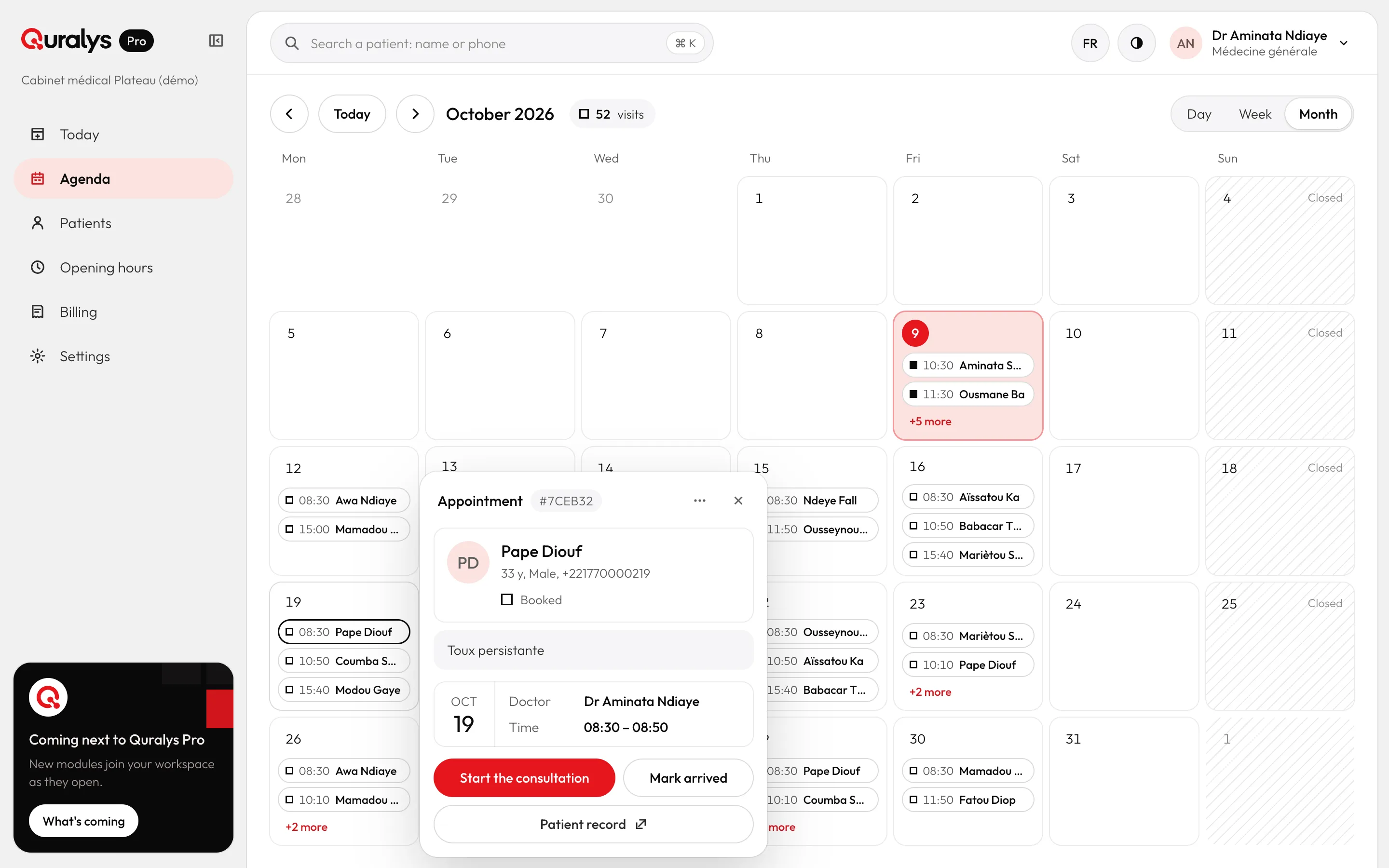
Your own availability rules, online booking day and night, no double bookings.
Wave or Orange Money at booking, with a receipt by SMS. Designed to cut no-shows.
Past visits, diagnoses coded in ICD-11, allergies and prescriptions as soon as the patient arrives.
Templates you adjust in seconds, signed, sent to the patient’s phone with a QR check.
A private room per appointment, built on Jitsi, with an audio-only fallback for weak networks.
SMS or WhatsApp reminders and the next appointment, without a secretary on the phone.
Embedded rooms, signed per appointment, with adaptive quality and an audio-only fallback for weak networks.
A video consult is the same appointment and the same record as a visit at the clinic.

Standard first, from the first table. Q-Core is written in TypeScript, so the FHIR R4 type definitions enforce the standard in code. Records are stored in FHIR shape, which means moving to a full FHIR server later is an import, not a rewrite.
{
  "resourceType": "Appointment",
  "status": "booked",
  "serviceType": [{ "text": "Cardiology consultation" }],
  "start": "2026-10-14T10:30:00Z",
  "end": "2026-10-14T11:00:00Z",
  "participant": [
    { "actor": { "reference": "Patient/awa-diop" },
      "status": "accepted" },
    { "actor": { "reference": "Practitioner/moussa-ndiaye" },
      "status": "accepted" }
  ],
  "slot": [{ "reference": "Slot/2026-10-14-1030" }]
}Patient, Practitioner, Organization, Schedule, Slot, Appointment, Encounter, MedicationRequest, Observation. Types are enforced in code, so the standard can’t drift.
Translates clinical events into the tracker events and aggregate indicators the national DHIS2 expects.
SMART on FHIR authorisation with patient consent, so existing apps read and write the same record instead of copying it.
ICD-11 for diagnoses, LOINC for lab results, ATC for medicines: codes any system understands.
“Nobody should retype a prescription. Write it once, in the international format, and every authorised door can open it.”
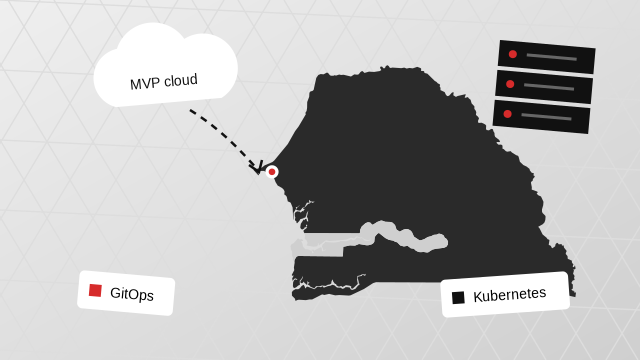
Two stages, one data model. The MVP runs on managed cloud services so the first month goes into product. Once validated, the platform moves to infrastructure inside Senegal, run as code on Kubernetes with GitOps.
Because records are FHIR-shaped from the start, the move from the cloud to Senegal is a migration of resources, not a redesign.