Nothing in Quralys is specific to one country except configuration. FHIR is international, DHIS2 runs national health information in many African countries, and mobile money is how the region pays. Each new country is a deployment, not a rebuild.
Prove the loop in Dakar
Private doctors first, then clinics, pharmacies and labs, then the national DHIS2. Data hosted in Senegal.
“01 Senegal” is the first chapter of an African health standard
- Senegal. Prove the loop, then connect to the national DHIS2. Data hosted in-country.
- UEMOA, then West Africa. Eight countries with one currency, a mostly French-speaking market, and a regional switch (GIM-UEMOA) linking mobile money operators.
- The continent. A shared FHIR layer between national systems, so records and tools work across borders, hosted locally in each country.
Standard first
Every action writes an HL7 FHIR R4 resource from day one. The data model is the one thing that never changes.
Connect, don’t compete
Existing apps, clinics and the national system plug into the same record instead of being replaced.
Free for patients
Patients never pay for the app, only for their consultation. Doctors pay a modest subscription for the tools they use every day.
Sovereign by design
Production data hosted in Senegal, processing declared to the CDP under law 2008-12.
Low-bandwidth first
Light pages, adaptive video, audio-only fallback and SMS when data drops.
Consent by default
Nothing is shared unless the patient allows it, and every access is logged.
“We don’t want to compete with the apps already in Senegal. We want to give them, and the national system, one shared language, so a patient’s record finally follows the patient.”
Each stage earns the next: real doctors before investors, investors before infrastructure, infrastructure before the national connection, and Senegal before the region.
Build the loop
Patient app and doctor console, video and digital ordonnance, a conference-ready demo.
Pilot
Three to five private doctors live, pricing validated, processing declared to the CDP.
Go sovereign
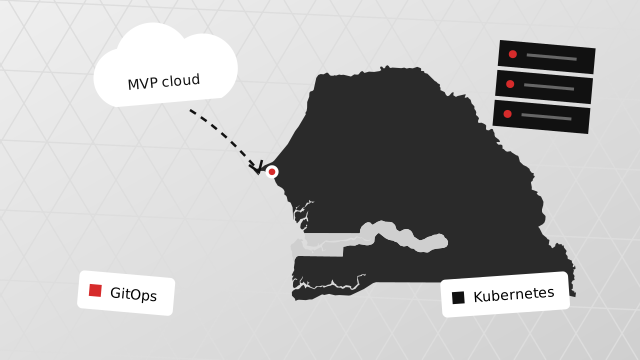
Move to Kubernetes in Senegal with HAPI FHIR and Keycloak; first partner app on the API.
Connect the country
A pilot of the national DHIS2 gateway, the pharmacy finder, clinics and lab results.
Sovereign by design. Health data falls under Senegal’s personal data law 2008-12, and processing must be declared to the CDP. Hosting production data in Senegal turns a compliance duty into a promise every national partner can rely on.
01Diamniadio
National data centreRun by Sénégal Numérique, the state’s digital agency.
02PAIX Dakar
Commercial data centreFacility in Les Mamelles, opening announced for 2026.
03Onix Dakar
Carrier-neutralAt the 2Africa cable landing station.
Sources: Datacenter Map, Connecting Africa, Onix.
Availability and pricing to confirm with each operator.
Built by a founder with a DevOps background and daily experience inside a Swiss healthcare software company, close to how mature clinical platforms are built and run, and an AI-assisted build process that compresses weeks of coding into days.
“Standard first, from the first table. Everything else can change; the data model can’t.”
We’re looking for
- Private doctors for the pilot
- Conference stages
- National health partners
- DHIS2 technical partners
- Seed funding for sovereign hosting