DHIS2 and FHIR explained: what Senegal's national health information system does, why it is not a patient record, and how middleware and IPS fill the gap.
In short
- DHIS2 has been the backbone of Senegal's national health information system for about a decade: it counts and follows programmes, but it is not built to be a clinic's patient record.
- DHIS2 treats FHIR as a way to exchange data, not as its storage format, so clinical software needs a translation layer to feed it.
- In DHIS2's June 2026 survey, about half of EMR integrations already used FHIR, and middleware was the most common place where data was mapped.
In a clinic in Medina, a general practitioner confirms that Awa has malaria and writes her a prescription (ordonnance). That one consultation produces two kinds of information: Awa's own record, which her next doctor will need, and one more malaria case, which the national health information system needs to count. In Senegal these two often travel on separate paths, and a 2023 Digital Square review described the country's health information systems as fragmented, with manual processes and little automation.
This article explains what DHIS2 is and what it does in Senegal, why it is not designed to hold patient records, what FHIR changes, and what the DHIS2 community's own June 2026 survey says about connecting clinics to it. No IT background is needed; the technical details sit in a clearly marked section.
What DHIS2 does in Senegal
DHIS2 is open-source software for collecting, analysing and displaying health data. Its development is coordinated by the HISP Centre at the University of Oslo, and according to DHIS2 it is used by more than 80 low- and middle-income countries as a national health data system.
Senegal started implementing DHIS2 in 2013 and moved to national scale between 2015 and 2016, according to a DHIS2 case study. The same source states that all health programmes in Senegal use it "as a single source for collecting aggregate data". In August 2026, HISP Rwanda described it as the backbone of the national health information system, deployed from central level down to districts and community health posts.
DHIS2 also has Tracker, a module that follows individuals rather than totals. By 2021 it was configured in Senegal to collect individual data on people living with HIV, and in 2020 Senegal was one of the first countries in West Africa to use it for COVID-19 case follow-up and contact tracing. The national tuberculosis programme uses Tracker to follow patient cohorts and treatment adherence.
Counting is not treating
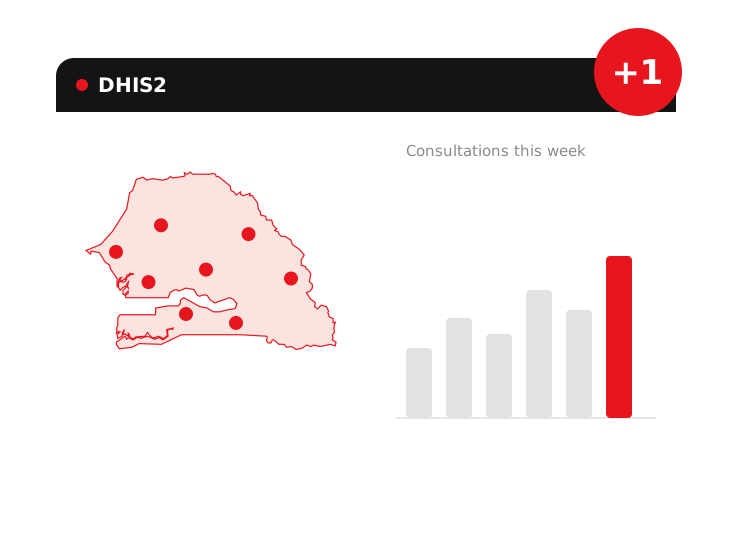
Most of what DHIS2 holds is aggregate data, meaning counts: how many malaria cases a health post saw in September, how many children were vaccinated, how many pregnant women came for a first visit. These totals feed dashboards that help national health authorities decide where to send staff, medicines or campaigns.
Tracker goes further, but it is organised around programmes. DHIS2 describes it as linking records to a person "that can be followed over time", for example a child's vaccination schedule. A clinic's record is wider. Dr Moussa Ndiaye, a cardiologist in Plateau, needs Awa's allergies, every current medicine, previous results and notes from other doctors, whatever the disease.
DHIS2 does not try to become that record, and its developers say so plainly:
"We see FHIR as an interoperability standard, rather than a replacement for our internal model." — DHIS2, DHIS2 and FHIR
What FHIR adds
FHIR (pronounced "fire") is the international standard for exchanging health information, published by the standards body HL7. It describes care as standard building blocks called resources: a Patient, an Encounter (a consultation), a Condition (a diagnosis), a MedicationRequest (a prescription). Any system that speaks FHIR reads those blocks the same way. Our page FHIR, simply explains it in five minutes.
DHIS2's own FHIR work, described on its DHIS2 and FHIR page, is about exchange rather than storage:
- data-entry forms can be mapped to FHIR Questionnaires, so a form filled in elsewhere can be read into DHIS2;
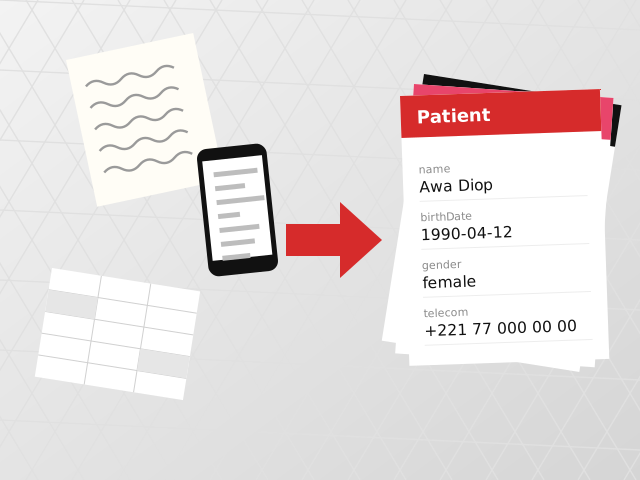
- Tracker patient data has been translated into a Patient record that conforms to the International Patient Summary (IPS, explained below);
- option lists and the hierarchy of health facilities can be published as standard FHIR resources;
- a country's DHIS2 configuration can be used to produce a FHIR implementation guide (a published rulebook stating exactly how data must look).
The same page cites FHIR-based exchange already at work in Africa: HIV case-based surveillance in Rwanda and health-workforce data in South Africa.
The middleware gap, in numbers
If DHIS2 does not store FHIR, something has to translate between a clinic's software and DHIS2. That something is usually middleware: a layer in between that receives data, converts it to the other side's format and passes it on.
On 1 June 2026 the DHIS2 core team published the results of its EMR–DHIS2 integration survey. An EMR (electronic medical record) is the software a clinic or hospital uses for patient files. The survey gathered 45 responses, which the author calls directional rather than statistically representative. The main findings:
- 15 of 28 community respondents already had some data exchange between an EMR and DHIS2, but only 3 of those 15 exchanged data in both directions;
- 8 of 15 current integrations used FHIR in some form, usually as an intermediate format inside the translation layer;
- mapping happened most often in middleware (6 of 15), ahead of the EMR (4) and DHIS2 itself (3), and OpenHIM, an open-source health middleware, was the tool most often named;
- in the separate survey of HISP groups, every respondent who answered the question on future standards named FHIR.
The author's conclusion is candid: "The protocol is settling, but the mapping work is still a challenge." Respondents reported duplicated records, weekly versus monthly reporting periods and weak validation between systems. Most integrations today are reporting pipelines rather than live synchronisation.
IPS: a shared summary of the patient
The International Patient Summary (IPS) is a small, agreed set of facts about a patient that any clinician can use, especially in unplanned care. HL7's IPS implementation guide describes it as "minimal and non-exhaustive; specialty-agnostic and condition-independent; but still clinically relevant". Its data set is also an international standard, ISO 27269, whose second edition was published in September 2025.
An IPS must contain three sections: problems, allergies and intolerances, and medicines. Immunisations, results, past procedures and medical devices are recommended. Picture Awa arriving at a hospital emergency room on a Sunday night: a summary from Dr Ndiaye's practice would tell the team about her blood-pressure treatment and her penicillin allergy before anyone has to ask.
For DHIS2, IPS gives a patient's identity and demographics a shared shape. DHIS2 says its IPS work should eventually support importing and exporting patient demographics, for example for referrals.
What it means for Senegal
For a clinic manager, the lesson is that nobody needs to replace DHIS2 or retype data into it. The national system keeps doing what it does well, counting and steering programmes, while clinical software keeps the patient record. Between them sits a translation layer, and FHIR is becoming the common language on the clinic side of it.
For doctors, the practical test is simple: does your software record diagnoses and prescriptions as coded data or as free text? Coded data (ICD-11 for diagnoses, LOINC for lab tests, see our article on health codes) can be counted automatically; free text has to be read by a person.
For national health authorities and partners, the survey points to where the real work lies: deciding which data travel per patient and which as totals, aligning codes, and validating early. WHO is also publishing its recommendations as FHIR guides; see our article on WHO SMART Guidelines.
For the technical reader
A typical flow looks like this. The clinic system writes an Encounter, a Condition coded in ICD-11 and a MedicationRequest. A middleware layer (OpenHIM, or Apache Camel, which DHIS2 itself uses) then does one of two things: it aggregates events into a value per facility, indicator and period (a FHIR MeasureReport is designed to carry such results), or it maps them to a Tracker enrolment and event for a programme patient. DHIS2 receives the result through its API.
The survey shows where projects stall: reusing identifiers so updates do not create duplicates, matching reporting periods, and mapping local terms to shared codes.
How Quralys approaches this
Quralys is a FHIR-native health platform being built in Dakar. It starts with booking, consultation notes and digital prescriptions for private doctors, and a pilot with three to five doctors is planned. Every action writes a standard FHIR R4 resource, so the data that runs a consultation is already in the shape the clinic side of the bridge needs.
A later module is a DHIS2 gateway: a translation layer that turns clinical events into the tracker events and indicators DHIS2 expects, using the IPS patient profile and international codes, with the patient's consent and without the patient's name in national totals. It does not replace DHIS2 and asks for no change to it. The ecosystem page shows where that layer sits.
Sources
- Digital Square: Transforming Senegal's healthcare system through an enterprise architecture approach (2023)
- DHIS2: About DHIS2
- DHIS2: Senegal, COVID-19 surveillance with DHIS2 Tracker (2021)
- HISP Rwanda: Numérique santé au Sénégal, plus de 10 ans de transformation sanitaire grâce à DHIS2 (2026)
- DHIS2: Tracker
- DHIS2: DHIS2 and FHIR
- DHIS2 Developer Portal: What we learned from the EMR–DHIS2 integration survey (June 2026)
- OpenHIM: Open Health Information Mediator
- HL7: International Patient Summary implementation guide, STU2
- HL7: Structure of the International Patient Summary
- ISO: ISO 27269:2025, Health informatics, International patient summary
Written by the Quralys team
Quralys is building a FHIR-native health ecosystem in Senegal: one record that clinics, pharmacies, labs, insurers and the national system can read, with the patient’s consent.
See it in practice
Private doctors in Dakar can join the pilot: online booking, prepaid consultations, digital ordonnances and video, free during the pilot.