Health insurance in Senegal explained: SEN-CSU, mutuelles de santé, IPM and private insurers, and how FHIR Coverage and Claim resources cut paperwork.
In short
- Health cover in Senegal is split across several schemes: SEN-CSU and the mutuelles, company IPMs, the State scheme for civil servants and private insurers.
- Most of the friction sits between care and payment: checking cover, guarantee letters, claims and reimbursement, often on paper.
- FHIR's Coverage, CoverageEligibilityRequest, Claim and ClaimResponse give every payer the same digital forms, so one consultation record can drive the reimbursement.
Awa works for a trading company in Dakar and is covered by its IPM, the company health scheme. Her mother, who lives in Kaolack, holds a SEN-CSU insurance card with a QR code. When both see Dr Moussa Ndiaye in Plateau in the same week, his secretary faces two schemes, two sets of rules and two ways of getting paid, each with its own forms and its own delays.
This article maps who pays for care in Senegal in 2026, explains how universal health coverage, mutuelles de santé and IPMs work today, and shows how a handful of FHIR resources can replace much of the paperwork between a consultation and its reimbursement.
Universal coverage, and who pays for care in Senegal
The World Health Organization defines universal health coverage as all people having access to "the full range of quality health services they need, when and where they need them, without financial hardship" (WHO). The gap is still wide: WHO estimates that about 4.6 billion people were not fully covered by essential health services in 2023, and that 2.1 billion faced financial hardship because of health costs in 2022.
Senegal created an agency dedicated to universal health coverage in 2015 (P4H). Cover is still delivered through several schemes that grew up separately, which is why a patient's protection often depends on where, and whether, they work.
| Scheme | Who it covers | How it works |
|---|---|---|
| SEN-CSU and mutuelles de santé | Mainly households outside formal employment | Voluntary membership, card with a QR code, contributions payable by mobile money |
| IPM (institutions de prévoyance maladie) | Private-sector employees and their families | Company or inter-company schemes; enrolment is mandatory for employers |
| State scheme for civil servants | Civil servants and their families | Paid from the State budget: 80% of medical care, but not medicines |
| Private insurers | Mostly higher-income people and companies | Commercial contracts |
The table draws on a 2022 review of Senegal's health financing by the P4H network, on a December 2025 UNDP release for the SEN-CSU card and payments, and on ICAMO's statements for IPMs.
SEN-CSU: from the CMU agency to principal insurer
The Agence sénégalaise de la couverture sanitaire universelle (SEN-CSU) is what the universal health coverage programme, the CMU, has become (Le Soleil, August 2025). Its director general, Dr El Hadji Séga Guèye, explained in October 2025 that under a decree of 27 March 2024 the agency acts both as the fund and as the principal insurer (Le Soleil, October 2025). The UNDP release describes it as having become the national health insurance fund.
That release also lists the tools behind the change: a mobile app for enrolment, payments and follow-up, a national management platform, GESTAM for managing mutuelles, SITFAC for tracking billing, and EDIRAMU for memberships and risks. Members can pay with Wave or Orange Money, cash has been progressively replaced since 2024, and the card with a QR code is recognised nationwide.
"We are gradually phasing out cash payments to build a model rooted in trust and efficiency." — Dr El Hadji Séga Guèye, UNDP release, December 2025
How many people are covered depends on what is counted. The UNDP release reports more than 53% of the population covered, against 10% ten years earlier, with a target of 75% by 2029. In his October 2025 interview, the director general put coverage at 23% "hors autres régimes de protection" (excluding other protection schemes). The gap mostly reflects what each figure includes, and it shows how hard coverage is to measure when every scheme keeps its own register.
The care network is widening. By June 2026, SEN-CSU had agreements with all public health facilities and nearly 350 private pharmacies, and it signed a framework agreement with the Alliance du secteur privé de la santé to open private clinics, laboratories, imaging centres and telemedicine services to its members (Le Soleil via AllAfrica).
Mutuelles de santé and IPM: how they work today
Mutuelles de santé are community-based, non-profit and voluntary health insurance schemes, governed by a 2003 law and by a 2009 UEMOA regulation. The model provides at least one mutuelle per commune and a union in each department that pools funds for hospital care (P4H).
Their place is changing. At a workshop in Dakar in February 2026, participants confirmed a consensus reached in November 2025 around a single national health insurance fund running a basic scheme for the whole population, with management delegated to IPMs, mutuelles, private insurers and other providers. On that occasion, SEN-CSU's director general deplored the very strong fragmentation of health insurance schemes in Senegal (Seneweb).
IPMs are the company schemes for private-sector employees and their families. Employers must enrol their staff, just as they must with the IPRES retirement fund. In October 2024, ICAMO, the body created in 2015 to coordinate mandatory health insurance, counted 164 registered IPMs; its 2022 report recorded nearly 4,000 member companies, a figure its head called "dérisoire" (derisory) given the number of formal businesses (AllAfrica). ICAMO is also rolling out a shared information system, SIAMO: by October 2024, 73 IPMs used certified software, and full deployment was still listed among its challenges (Seneweb).
Where the paperwork piles up
Between the consultation and the payment, the same four questions come back for every scheme:
- Is this patient covered, by whom, and for what?
- Does this treatment need prior approval?
- What exactly was done, and at what price?
- How much will the payer reimburse, and when?
Today the answers still travel largely on paper and by phone. In Diourbel, for example, the agency's desks in health centres and hospitals issue guarantee letters and medicine order forms to beneficiaries (AllAfrica). Each payer tends to have its own forms and procedures, so a clinic like Dr Ndiaye's describes the same consultation several times, in several formats, and the payer then rereads it to check it.
Four FHIR resources that replace the forms
FHIR, the international standard for exchanging health data (see FHIR, simply), has a whole financial module for these exchanges (HL7). A few resources, its standard building blocks, do most of the work:
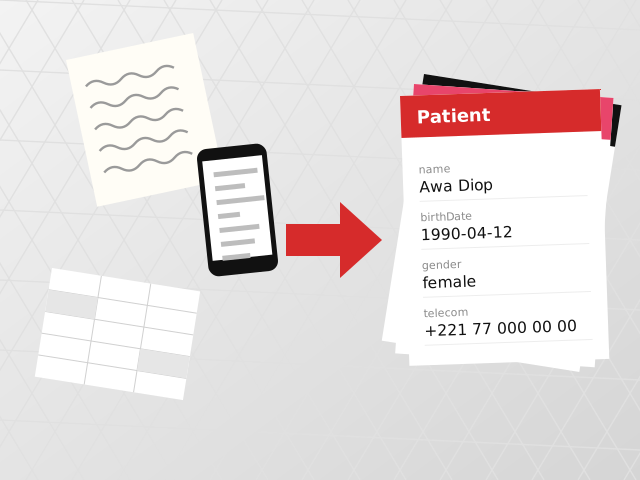
- Coverage holds what is printed on an insurance card: who is covered, by which payer, under which plan, for which period, and what the patient pays. Awa's IPM card and her mother's SEN-CSU card become two Coverage records.
- CoverageEligibilityRequest, with its response, lets the clinic ask the payer whether the cover is valid and in force, what it includes, and whether prior approval is needed.
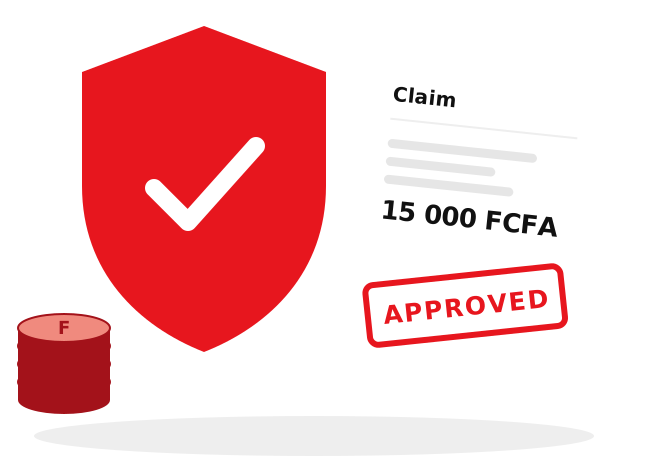
- Claim is the request for payment sent by the provider. The same resource serves three uses: a claim for care already given, a preauthorization for planned care, and a predetermination to explore what would be covered.
- ClaimResponse is the payer's decision: what is accepted, what is paid, what remains for the patient.
Around them, ExplanationOfBenefit gives the patient a summary, while PaymentNotice and PaymentReconciliation report the payment itself.
Key idea The record that tells the doctor what happened can also tell the payer what to pay. Coverage says who pays, Claim says what was done, ClaimResponse says what is paid, and nothing is retyped in between.
India has already made this choice. Its National Health Authority built the National Health Claims Exchange on FHIR R4 profiles of these resources, starting with cashless claims, from eligibility checks and pre-authorisation to claims and payments (NRCeS). Our ecosystem page shows where payers sit next to clinics, pharmacies and laboratories.
For the technical reader
Coverage.payorreferences the Organization that pays: SEN-CSU, an IPM, a mutuelle or an insurer.Coverage.typecan express a social programme,classcarries plan and group, andcostToBeneficiaryexpresses the patient's share, such as 20% on a scheme that pays 80%.CoverageEligibilityRequest.purposetakes validation, benefits, discovery or auth-requirements.Claim.useis claim, preauthorization or predetermination. Items should carry coded diagnoses (ICD-11) and products (ATC plus a national list), so the payer can decide without reading free text.- Slow decisions rely on Task for status, and on CommunicationRequest and Communication when the payer needs more information.
- In a delegated model where SEN-CSU works with IPMs, mutuelles and insurers, one shared national profile of these resources would let a clinic send the same Claim whatever the payer.
- Claims carry clinical data: send only what the decision requires, within the patient's consent.
How Quralys approaches this
Quralys is pre-launch, and insurance is not part of its first version. Payers are on the same map from the start: the record is designed so that a consultation can later carry Coverage and Claim resources for insurers, mutuelles and IPMs, and the insurance module is planned after the pilot and the first pharmacy and laboratory connections.
For now, patients pay their consultation fee with Wave, Orange Money or a card, and that payment is recorded as a FHIR ChargeItem; our article on mobile money and healthcare covers that side. Insurers, mutuelles and IPMs interested in a shared claims format can contact the team.
Sources
- WHO: Universal health coverage, fact sheet (December 2025)
- P4H: Institutional framework of health financing in Senegal (2022)
- Le Soleil: SEN-CSU aims for 75% coverage by 2029 (August 2025)
- Le Soleil: interview with Dr El Hadji Séga Guèye, director general of SEN-CSU (October 2025)
- AllAfrica (UNDP release): Senegal accelerates the digitalization of its health insurance system (December 2025)
- AllAfrica (Le Soleil): towards the enrolment of private clinics (June 2026)
- Seneweb: SEN-CSU drives an integrated health insurance system (February 2026)
- AllAfrica: ICAMO denounces the low number of IPM members (October 2024)
- Seneweb: mandatory health insurance coordination, the challenges ahead (October 2024)
- AllAfrica: universal health coverage in Diourbel, nearly 30,000 people enrolled in 2025 (February 2026)
- HL7 FHIR R4: Financial module
- NRCeS: National Health Claims Exchange FHIR profiles (India)
Written by the Quralys team
Quralys is building a FHIR-native health ecosystem in Senegal: one record that clinics, pharmacies, labs, insurers and the national system can read, with the patient’s consent.
See it in practice
Private doctors in Dakar can join the pilot: online booking, prepaid consultations, digital ordonnances and video, free during the pilot.