Mobile money and healthcare in Senegal: latest BCEAO figures, Wave and Orange Money fees, the 2025 transfer tax, prepaid consultations, receipts and FHIR.
In short
- Senegal is the largest e-money market in the UEMOA: 42.6 million accounts were open at the end of 2024, of which 14.6 million were active (BCEAO).
- Prepaying a consultation by Wave or Orange Money turns a phone promise into a confirmed booking, but it needs clear rules for receipts, refunds, fees and tax.
- In FHIR, a ChargeItem records what is billed for a consultation and a PaymentNotice reports a payment's status, so payment data can follow the same standard as the medical record.
Awa wants a follow-up appointment with Dr Moussa Ndiaye, her cardiologist in Plateau. Today that usually means calling the practice several times, getting a slot written in a paper agenda and bringing cash on the day, ideally with the right change. If she cannot come, the slot stays empty, and the practice often finds out only when the hour has passed.
Yet Awa already pays her electricity bill, her shopping and her family transfers from her phone. This article sets out the most recent verifiable figures on mobile money in Senegal, with the year each one refers to, what paying for a consultation by phone changes, what it costs in fees and tax in 2026, and how a payment can be recorded with standard health data resources.
Mobile money in Senegal: the latest figures
Mobile money is money held in an account tied to a phone number; banking regulators call it electronic money, or e-money. In the West African Economic and Monetary Union (UEMOA), it is supervised by the central bank, the BCEAO, whose annual report on digital financial services for 2024, published in March 2026, gives the latest country-level detail.
| Indicator (Senegal) | Figure | Period |
|---|---|---|
| E-money accounts opened | 42.6 million | End of 2024 |
| Active accounts | 14.6 million (34.4%) | 2024 |
| Number of transactions | 2.87 billion | 2024 |
| Share of UEMOA transactions | 24.1% of volume, 30.2% of value | 2024 |
| Share of e-money held in the UEMOA | 29.7% | End of 2025 |
| Resident population | 18.1 million | 2023 census |
Sources: BCEAO (2024 figures); UMOA Banking Commission, as reported by Le Soleil (2025 figure); ANSD, fifth general census (population).
Two things stand out. Senegal counts far more accounts than residents, and only about one account in three was active in 2024, so the number of accounts says little about how many people actually pay by phone. On activity, though, Senegal leads the Union: it handled nearly a quarter of all e-money transactions in 2024.
The most recent annual report of the UMOA Banking Commission, covering 2025, puts the e-money held in wallets across the Union at 1,923.2 billion FCFA at the end of 2025, up 35.2% in a year, with Senegal holding the largest share (29.7%). According to figures from the same source reported by Senego in August 2026, Wave held about 80% of the e-money in Senegal (459 billion FCFA) and Orange Money about 19% (106 billion FCFA).
The regional trend points the same way. The GSMA, the association of mobile operators, reports in its State of the Industry Report on Mobile Money 2026 that West Africa processed 498 billion US dollars in mobile money transactions in 2025, up 34% on 2024, across 517 million registered accounts.
Why paying for a consultation by phone matters
Cash has hidden costs for a practice. Someone has to collect it, give change, write a receipt and reconcile the till in the evening. A mobile money payment leaves a dated, traceable transaction with a reference number, which is already half of a receipt.
The larger issue is the empty slot. A systematic review of 105 articles published in Health Policy in 2018 found an average no-show rate of about 23%, and the highest rates in the studies from Africa (43.0%). Each missed appointment is time a doctor could have given to another patient waiting for a slot.
Prepaying at booking changes the nature of the appointment. When Awa pays as she books, she has made a firm commitment, the practice knows in advance who is coming, and a clear cancellation rule can free the slot for someone else. How much prepayment reduces no-shows in Dakar practices has not been measured publicly; it is a hypothesis worth testing with real doctors rather than a promise.
Key idea Paying by phone is not only about convenience. A prepaid booking is a confirmed booking, with a transaction reference that can become the receipt, the accounting entry and, if needed, the refund.
What a payment costs in 2026: fees and tax
Fees have fallen since 2021. After Wave entered the market with a flat 1% transfer fee, Orange Money cut its prices in June 2021 and, in November 2021, lowered its transfer fee to 0.8% and made withdrawals free.
For a practice, the relevant figure is the merchant fee. Wave's business page states that payments are free for customers, and that the merchant pays nothing on the first 20,000 FCFA received each day, then 1%. As an illustration, a practice receiving ten payments of 20,000 FCFA in a day would pay 1% on the 180,000 FCFA above the threshold, or 1,800 FCFA. Terms differ from one operator to another, so a practice should check each operator's current merchant grid before going live.
Tax is the newer element. Under law 2025-17 of 27 September 2025, a transfer tax (TTA) of 0.5% applies to transfers, payments and withdrawals, capped at 2,000 FCFA per operation; withdrawals are taxed only above 20,000 FCFA in 24 hours, and cash deposits and salary payments are exempt. Operators began collecting it in December 2025, as reported by Le Journal de l'Economie Sénégalaise. The GSMA's 2026 report notes that Senegal's new mobile money taxes created uncertainty about future costs, so it is worth checking how each operator applies the tax to merchant payments.
Receipts, refunds and reconciliation
The unglamorous part of payments is what happens after the money moves. A useful receipt names the practice and the doctor, the date and time of the appointment, the amount, the operator and the transaction reference. Sent to the patient's phone, it replaces the handwritten slip that gets lost.
Refunds need rules written down before anyone pays. If Dr Ndiaye cancels, Awa should be refunded automatically; if Awa cancels late, the practice's policy should already be clear on the booking screen. In both cases the refund should point to the original transaction, not live in a separate notebook.
Reconciliation is where linked data saves the most time. When each payment carries the appointment it belongs to, matching the operator's statement with the day's consultations becomes a check, not an afternoon of detective work.
Interoperability between providers is also improving. On 30 September 2025, the BCEAO launched PI-SPI, a regional instant payment platform designed to let users send and receive funds between banks, microfinance institutions and e-money issuers.
For the technical reader: ChargeItem and PaymentNotice
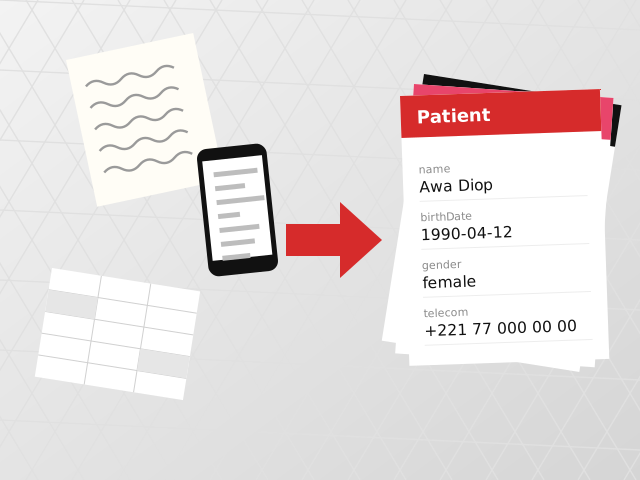
FHIR, the international health data standard explained in FHIR, simply, has financial resources alongside the clinical ones. They let a payment be linked to the care it pays for, in a form any authorised system can read.
- ChargeItem records that a product or service was provided to a patient, for billing. Its
contextpoints to the Encounter (the consultation), andcodeidentifies what is charged; the price comes from a ChargeItemDefinition or apriceOverride. The specification is explicit that a ChargeItem is not a financial transaction itself, but the source data for one. In FHIR R4 it is still a trial-use resource (maturity level 0). - PaymentNotice reports the status of a payment, with a required
amount,recipientand a reference to a PaymentReconciliation. Its typical use is between payers and providers, for example to say that the payment for a Claim has been issued or cleared. Itsidentifierelement can carry a business identifier, such as the operator's transaction reference.
In a direct patient payment, ChargeItem does most of the work: Awa's consultation produces one ChargeItem linked to the Encounter, and the mobile money reference travels with it. The same resources reappear when an insurer or a mutuelle pays part of the bill, a case covered in our article on insurers, mutuelles and FHIR claims.
How Quralys approaches this
Quralys, a FHIR-native health platform being built in Dakar, keeps one rule: patients never pay for the app, only their consultation fee, by Wave, Orange Money or card through a local aggregator. Doctors pay a modest subscription for their tools, with a free starter tier.
In the first version, booking and payment form one step, and the payment writes a ChargeItem next to the Appointment and the Encounter, so the money and the care share the same record. Quralys is pre-launch; whether prepayment reduces no-shows in practice is one of the questions the planned pilot with three to five private doctors in Dakar is meant to answer. The page for doctors explains the pricing model and the pilot.
Sources
- BCEAO: Rapport annuel sur les services financiers numériques dans l'UEMOA, 2024 (published March 2026)
- Le Soleil: UEMOA, le Sénégal en tête sur la microfinance et la monnaie électronique en 2025 (August 2026)
- Senego: Mobile money au Sénégal, Wave écrase la concurrence avec 80 % du marché (August 2026)
- ANSD: Principaux résultats du 5e Recensement général de la population et de l'habitat (RGPH-5, 2023)
- GSMA: The State of the Industry Report on Mobile Money 2026
- Health Policy: Dantas et al., No-shows in appointment scheduling, a systematic literature review (2018)
- Sikafinance: Sénégal, Orange Money fait passer ses frais à 0,8 % pour bousculer Wave (November 2021)
- Wave: Wave Business
- Le Journal de l'Economie Sénégalaise via AllAfrica: Taxe sur les transferts d'argent (December 2025)
- BCEAO: Lancement de la plateforme interopérable du système de paiement instantané (PI-SPI)
- HL7 FHIR R4: ChargeItem resource
- HL7 FHIR R4: PaymentNotice resource
Written by the Quralys team
Quralys is building a FHIR-native health ecosystem in Senegal: one record that clinics, pharmacies, labs, insurers and the national system can read, with the patient’s consent.
See it in practice
Private doctors in Dakar can join the pilot: online booking, prepaid consultations, digital ordonnances and video, free during the pilot.