Health data fragmentation in Senegal: paper agendas, siloed apps and separate public programmes. What reviews found and what it costs patients and doctors.
In short
- In Senegal, health data is split between paper agendas, private apps and public programme systems that were never designed to share a record.
- Reviews by WHO, Digital Square, PATH and the Transform Health coalition describe the same pattern: many initiatives, few shared standards and weak links between systems.
- Patients pay for the gaps with repeated histories and tests, doctors with retyping, and a shared standard such as FHIR is the missing piece.
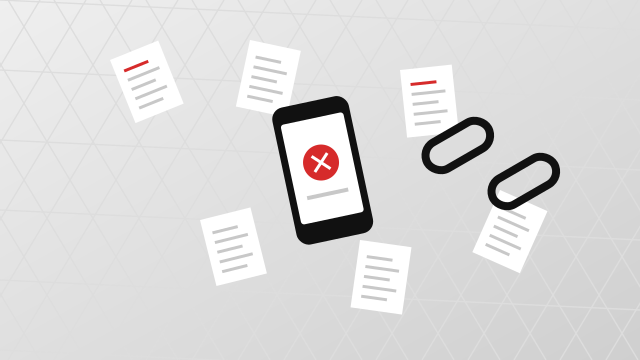
Awa lives in Parcelles Assainies and has high blood pressure. The first time she sees Dr Moussa Ndiaye, a cardiologist in Plateau, she brings a plastic sleeve of papers: a handwritten prescription (ordonnance) from a health post, results from a laboratory in Medina, and a phone full of WhatsApp photos. Dr Ndiaye starts the consultation by rebuilding a history that already exists, in pieces, in several places.
This is what health data fragmentation looks like in Senegal. This article explains where the pieces sit, what independent reviews have found, what the gaps cost patients and doctors, and why adding more apps will not, on its own, join them up.
Three places where the record breaks
Health information in Senegal is not missing. It is scattered across tools built at different times, for different purposes, and that rarely share a format.
Paper at the front desk
For many patients, booking a doctor still means calling a secretariat at peak hours, and the slot ends up in a paper agenda. The prescription is handwritten and leaves the clinic in the patient's bag. A 2024 landscape analysis for the Transform Health coalition speaks of "the reign of paper in public entities" and observes that most facilities remain far from structured, secure digital systems.
Apps that work alone
Senegal also has an active digital health scene: booking platforms, teleconsultation services, pharmacy finders. Each solves a real problem. But each keeps its own records in its own format, so a patient who uses two services ends up with two partial histories that cannot see each other.
This is not new. According to the same Transform Health analysis, a national evaluation of digital health in 2015 found "around fifty isolated initiatives" and "a fragmented ecosystem". The analysis adds that e-health projects are "compartmentalised because they operate in 'project mode'", and that the catalogue of existing solutions is not being kept up to date.
Public programmes built to report
On the public side, DHIS2 (an open-source platform for collecting and analysing health statistics) has been the backbone of the national health information system for more than ten years. It is deployed from central level down to health districts and community health posts, and the national tuberculosis programme uses its Tracker module to follow patients, according to HISP Rwanda (2026).
But DHIS2 was designed mainly to count and steer, not to hold a full clinical record. The Transform Health analysis states that "DHIS2 is not a data hosting server" and that its Tracker module is not natively designed to act as a patient record. Other systems sit around it: at the time of the analysis, the link between DHIS2 and the management software of the national medicines supply agency (SEN PNA) relied on CSV file transfers, "whereas interoperability presupposes the existence of a layer".
The pattern repeats in disease surveillance. For vaccine-preventable diseases, a 2025 country brief published by PATH found paper tools combined with three digital systems, and noted that "no data exchange standards like HL7 FHIR or ADX are currently in use".
What the reviews found
Several independent reviews, written for different purposes, describe the same picture.
- WHO Regional Office for Africa (2024). Across the continent, a policy brief on health data digitalization points to "extreme fragmentation of interventions, with investments made primarily in pilot initiatives that are rarely scaled up".
- Digital Square (2023). Senegal's enterprise architecture work starts from "fragmented information systems, lack of coordination, manual processes, and absence of automation".
- Transform Health coalition (2024). Citing the Global Digital Health Monitor, the landscape analysis gives Senegal 3 out of 5 for overall digital health maturity, but 1 out of 5 for "architecture and interoperability of existing platforms".
- DHIS2 community (2026). In a June 2026 survey on linking patient record systems with DHIS2, implementers across countries listed fragmented system landscapes, which make coordination between teams difficult, among their recurring challenges.
"Fragmentation of the health system, in general, and of the health information system (HIS), in particular, has been one of the major problems in improving health services in Africa."
— WHO Regional Office for Africa, Health data digitalization in Africa (2024)
What fragmentation costs patients
For Awa, fragmentation is not abstract. Each new clinic starts her history from zero. She repeats her allergies, her treatments and her past results from memory, and hopes nothing important is forgotten.
If a paper prescription is lost, she goes back to the doctor. If an earlier result cannot be found or trusted, the test may be done again. A doctor who cannot see every medicine she takes is working with less information than actually exists somewhere in the system.
Much of this falls on the household. In 2023, out-of-pocket payments made up about 44% of current health expenditure in Senegal, according to World Bank data drawn from WHO's health expenditure database. When a consultation or a test has to be repeated because the record did not follow the patient, it is often the family that pays twice.
What it costs doctors and clinics
For Dr Ndiaye, fragmentation shows up at the front desk and in the consultation room. The secretariat is saturated at peak hours, slots booked by phone are forgotten and stay empty, and the patient's history arrives on paper, to be summarised or retyped by hand.
Digital tools help, but each new app is one more place to enter the same data. A practice that uses a booking app, a separate teleconsultation service and its own billing spreadsheet holds three partial copies of the same patient. And when systems do not share a format, reporting to the national system becomes a separate task rather than a by-product of care already recorded.
Key idea Senegal does not lack health software. It lacks a shared language between systems, so that information written once can be read wherever the patient allows it.
Why more apps alone will not fix it
It is tempting to think that one more app, better designed, will solve the problem. The evidence points elsewhere. WHO's regional office notes that investment has gone mainly into pilot projects that rarely scale. When Senegal validated a national policy framework for digital health in April 2025, national health authorities described the digital initiatives already under way as "often implemented in a scattered way" (our translation) and called for better coordination, as WeAreTech Africa reported.
The rules are still being written. The 2025 PATH brief described the national interoperability framework as still "in draft form". A digital health bill, which would among other things frame the patient record, was still under review within government in June 2026, according to the Senegalese press agency APS.
What is missing is not another silo. It is a common layer: a shared way of writing health records so that any authorised system can read them.
What would connect the pieces
Interoperability (the ability of different systems to exchange data and use it without retyping) rests on a few simple ingredients.
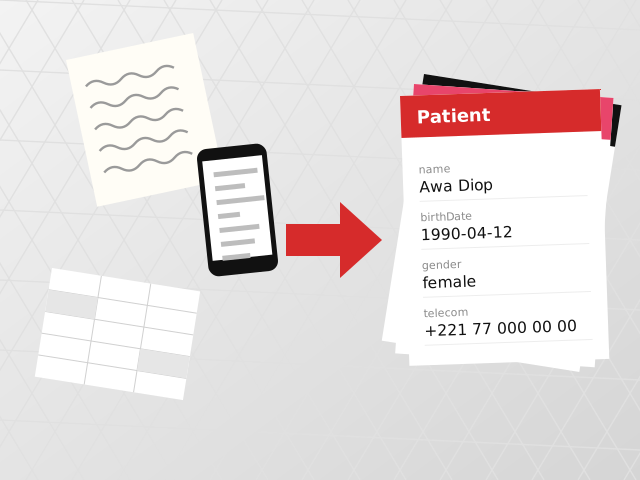
- A shared format. HL7 FHIR (Fast Healthcare Interoperability Resources, pronounced "fire") defines standard building blocks, called resources, for a patient, an appointment, a prescription or a lab result. Our plain-language guide to FHIR explains how it works.
- Shared codes. International code lists such as ICD-11 for diagnoses and LOINC for lab tests, so that "palu" and "malaria" mean the same thing to every system.
- Consent and access rules. The patient decides who can read what, and every access is logged.
- A bridge to the national system. A translation layer that turns clinical events into the indicators DHIS2 expects. The DHIS2 team itself sees FHIR "as an interoperability standard, rather than a replacement" for its internal model, and in the June 2026 survey every HISP group (the local teams that implement DHIS2) that answered the question named FHIR as the future standard. We cover this in detail in DHIS2 and FHIR.
None of these ingredients requires replacing what already works. The apps, the clinics and DHIS2 can all stay. What changes is that they agree on how to write things down.
How Quralys approaches this
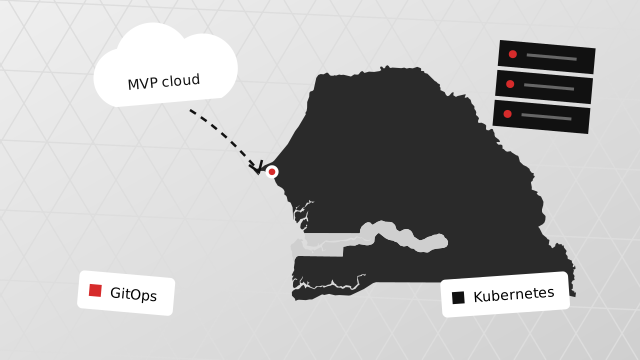
Quralys is being built around that missing layer. Its first modules, a booking app for patients and a practice suite for private doctors in Dakar (a pilot with 3 to 5 doctors is planned), write every step as a standard FHIR R4 resource: the appointment, the consultation, the ordonnance. Existing Senegalese apps are meant to connect to the same record through a partner API with the patient's consent, rather than being replaced, as we explain in interoperability, not competition.
Production data is to be hosted in Senegal, and a gateway to DHIS2 is on the roadmap. You can see how the pieces are meant to fit together on our ecosystem page.
Sources
- WHO Regional Office for Africa: Health data digitalization in Africa, AHOP policy brief (2024)
- Transform Health coalition: Landscape analysis, digitisation and health data governance in Senegal (January 2024)
- Digital Square: Transforming Senegal's health care system through an enterprise architecture approach (2023)
- HISP Rwanda: Numérique et santé au Sénégal, plus de 10 ans de transformation sanitaire grâce à DHIS2 (2026)
- PATH: VPD surveillance systems in Senegal, country brief (July 2025)
- DHIS2: EMR-DHIS2 integration survey (June 2026)
- DHIS2: DHIS2 and FHIR
- World Bank: Out-of-pocket expenditure (% of current health expenditure), Senegal
- WeAreTech Africa: Le Sénégal se dote d'un cadre politique pour encadrer la santé numérique (April 2025)
- APS via AllAfrica: Plaidoyer pour l'adoption d'une loi sur la santé numérique (June 2026)
Written by the Quralys team
Quralys is building a FHIR-native health ecosystem in Senegal: one record that clinics, pharmacies, labs, insurers and the national system can read, with the patient’s consent.
See it in practice
Private doctors in Dakar can join the pilot: online booking, prepaid consultations, digital ordonnances and video, free during the pilot.